
Plumbing in Middletown, Ohio
Middletown is an older industrial city on the Great Miami River, northeast of Hamilton, and many of its houses date from the early 1900s to the 1950s.
What Is Behind the Walls of an Older Middletown House
A house built in the 1920s has usually been through several rounds of plumbing work. It is common to find the original galvanized steel water lines in one part of the basement, copper added a few decades later in another, a stretch of PEX from a recent bathroom, and cast-iron drains tying it all together. Each of those materials ages in its own way, and the places where they meet are often where trouble starts: a copper fitting screwed straight into galvanized steel without a dielectric union corrodes at the joint.
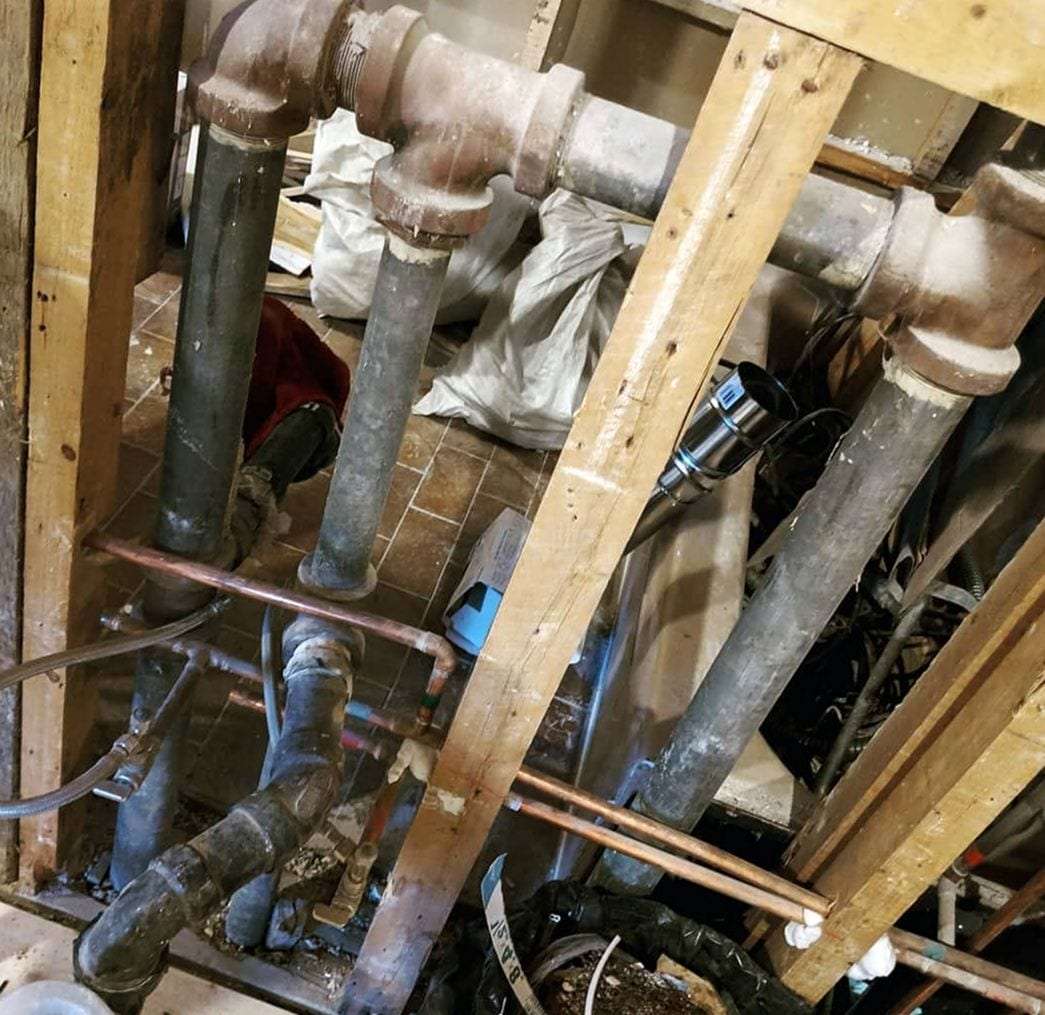
Nixon Bowen is often called to older houses like these, and worn shutoff valves and corroded pipe tend to show up once a wall is opened. If something unexpected turns up partway through a job, he calls you before going further, so the decision about a bigger repair stays yours.
Galvanized Water Lines and Falling Pressure
Galvanized steel rusts from the inside. Over the decades the rust narrows the pipe until a half-inch line carries a fraction of the water it once did, which is why the upstairs shower in an older house can drop to a trickle when someone opens the kitchen tap. Other signs are brown water after the supply has been off for a while, and leaks at the threaded joints, where cutting the threads left the pipe wall thinnest.
Patching galvanized pipe buys time, but the pipe on either side of a repair is usually in the same shape. Replacing it with copper or PEX brings the pressure back and ends the rusty water, and in a lived-in house it can be done in stages: the main line from the meter first, then the runs to the kitchen and bathrooms. A plumber usually keeps the wall openings to a few access points and runs the new lines along the basement ceiling where possible. Repiping is one of the larger installs and replacements, and one of the most noticeable once it is done.
Cast-Iron Stacks and Drain Lines
Cast iron is heavy and quiet, and in many Middletown houses it is still doing its job after most of a century. It fails from the inside too. Rust scale builds up in the horizontal runs and catches paper, and the bottom of a pipe can corrode through or split along its length. Leaks at the old lead-and-oakum joints, a sewer smell in the basement, or a dark stain on a wall near the stack are the usual signs.
A damaged section can often be cut out and replaced with PVC joined by no-hub couplings, once the stack above it is clamped and supported so it cannot drop. That kind of repair keeps the sound pipe in place and replaces only what has failed, which is usually the sensible order of things in an old house.
Clay-Tile Sewer Laterals and Tree Roots
The sewer lateral that carries waste from an older house to the city main is often clay tile, laid in short sections with a joint every couple of feet. Mature street trees send roots into those joints looking for water, and the roots grow into a mat that catches everything flushed down the line. The pattern is familiar: a gurgle from the basement floor drain when the washing machine empties, a toilet on the lowest floor that is slow to clear, then water coming up through the floor drain itself.
Cutting the roots out with a cable machine clears the line, but roots grow back, so a camera inspection afterwards is worth the time. It shows every joint, and whether the pipe is cracked, offset or sagging, and that decides whether regular root cutting is enough or a section needs replacing. Both are part of everyday drain and sewer work.
Basement Floor Drains and Tight Water Heater Corners
Most older basements have a floor drain, and most floor drains are ignored until they cause a problem. The trap under the grate holds water that blocks sewer gas; if the drain is never used, that water dries out and the basement starts to smell. Pouring a bucket of water into it every month or two takes care of that. A floor drain that backs up is a different matter, because it is usually the lowest opening on a sewer line that is blocked farther out.
Water heaters in these basements are often squeezed under the stairs or between a foundation wall and the furnace, with a narrow stairway as the only way in or out. A replacement has to fit that space and that stairway, keep its clearances and vent properly. When the old furnace has been swapped for a high-efficiency model that vents out the side wall, a gas water heater can be left venting alone into a chimney sized for two appliances, and that chimney may need a liner. Those details are worth sorting out before the old tank comes out, and they are part of any water heater replacement in an older house.
Frozen Pipes in Older Exterior Walls
Walls in houses of this age often have little or no insulation, so a kitchen sink on an outside wall, a bathroom over an unheated porch or a pipe through the crawl space under a back addition can freeze in a hard cold snap. On the coldest nights, open the cabinet doors under sinks on outside walls, let a faucet drip, and keep porch and garage doors shut. Learn where the main shutoff is before winter, because closing it right away is what limits the damage. A pipe that has burst is a reason to call for urgent service.
Book a Plumbing Visit in Middletown
Middletown addresses are in ZIP codes 45042 and 45044, and both are on the list of communities Rossville Plumbing works in. Describe the problem in the form below, or call (513) 902-3413.
Thank you. Your request reached us, and we will get back to you by phone or email.
Your request did not go through. Please call us at (513) 902-3413 and we will set it up by phone.
An old pipe acting up in a Middletown house?